What Is the Big Mac Price?
The Big Mac price refers to what you pay for McDonald's signature burger — a standardized product available in over 100 countries. McDonald's uses localized pricing strategies where franchises set prices based on local market conditions rather than a uniform global rate.
In the United States, the average Big Mac costs $6.12 as of January 2026, reflecting ongoing economic trends and regional variations.
Globally, prices convert to USD equivalents for comparison: Switzerland tops at $9.08 (48% above US) while Taiwan offers it for just $2.47.
Variations stem from purchasing power parity (PPP), where identical goods should theoretically cost the same when adjusted for currency strength. Real-world factors distort this principle dramatically.
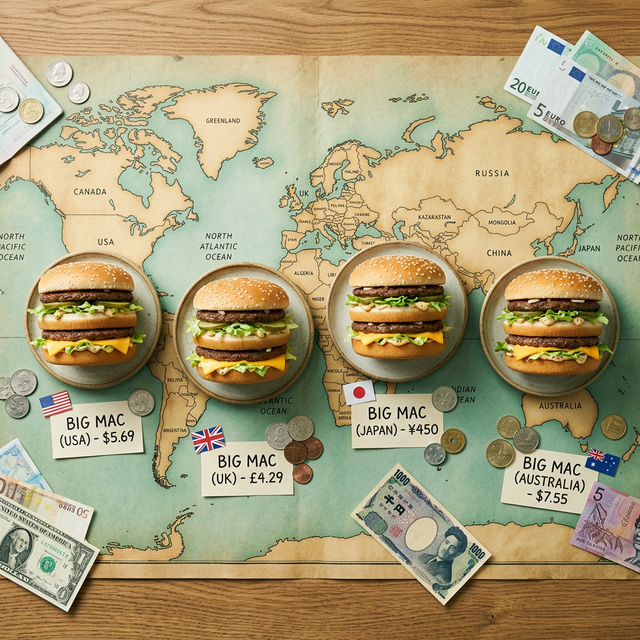 Big Mac prices vary dramatically worldwide
Key Economic Factors Influencing Price
Higher wages in wealthy nations
Lower costs in emerging markets
Taxes on beef and ingredients
Prime location costs vary hugely
Big Mac Price Worldwide
Most Expensive vs Cheapest Countries
💎 Most Expensive Countries
| Country | Price (USD) |
|---|---|
| 🇨🇭 Switzerland | $9.08 |
| 🇺🇾 Uruguay | $8.76 |
| 🇳🇴 Norway | $7.52 |
| 🇸🇪 Sweden | $7.26 |
| 🇩🇰 Denmark | $7.14 |
| 🇬🇧 Britain | $7.08 |
| 🇪🇺 Euro area | $7.06 |
| 🇮🇱 Israel | $6.36 |
| 🇵🇱 Poland | $6.25 |
| 🇨🇴 Colombia | $6.21 |
| 🇲🇽 Mexico | $6.17 |
| 🇺🇸 USA (Average) | $6.12 |
| 🇨🇷 Costa Rica | $6.04 |
| 🇹🇷 Turkey | $5.91 |
| 🇸🇬 Singapore | $5.78 |
| 🇦🇺 Australia | $5.69 |
| 🇨🇦 Canada | $5.54 |
| 🇦🇷 Argentina | $5.53 |
| 🇨🇿 Czech Rep. | $5.50 |
| 🇨🇱 Chile | $5.42 |
| 🇱🇧 Lebanon | $5.36 |
| 🇦🇪 UAE | $5.17 |
| 🇸🇦 Saudi Arabia | $5.07 |
| 🇭🇳 Honduras | $5.06 |
| 🇵🇪 Peru | $5.03 |
| 🇭🇺 Hungary | $4.99 |
| 🇳🇿 New Zealand | $4.94 |
🏷️ More Affordable Countries
| Country | Price (USD) |
|---|---|
| 🇧🇭 Bahrain | $4.77 |
| 🇳🇮 Nicaragua | $4.75 |
| 🇶🇦 Qatar | $4.67 |
| 🇰🇼 Kuwait | $4.54 |
| 🇧🇷 Brazil | $4.45 |
| 🇬🇹 Guatemala | $4.30 |
| 🇹🇭 Thailand | $4.30 |
| 🇲🇩 Moldova | $4.09 |
| 🇻🇪 Venezuela | $4.05 |
| 🇷🇴 Romania | $3.98 |
| 🇴🇲 Oman | $3.97 |
| 🇦🇿 Azerbaijan | $3.90 |
| 🇵🇰 Pakistan | $3.86 |
| 🇰🇷 South Korea | $3.74 |
| 🇨🇳 China | $3.66 |
| 🇯🇴 Jordan | $3.53 |
| 🇲🇾 Malaysia | $3.39 |
| 🇿🇦 South Africa | $3.36 |
| 🇭🇰 Hong Kong | $3.21 |
| 🇺🇦 Ukraine | $3.19 |
| 🇯🇵 Japan | $3.03 |
| 🇻🇳 Vietnam | $2.89 |
| 🇵🇭 Philippines | $2.84 |
| 🇪🇬 Egypt | $2.64 |
| 🇮🇩 Indonesia | $2.52 |
| 🇮🇳 India | $2.52 |
| 🇹🇼 Taiwan | $2.47 |
🇮🇳 Regional Adaptation Example
India's vegetarian-friendly Maharaja Mac (using chicken or veggie patties) costs less partly because beef isn't widely consumed, reducing import costs and aligning with local dietary preferences.
Why Does Big Mac Price Differ by Country?
Big Mac prices vary globally due to complex economic factors that distort the theoretical purchasing power parity principle.
👷 Labor Costs — The Biggest Factor
Countries with strong unions and high minimum wages naturally have more expensive fast food. Switzerland's $9.08 Big Mac reflects both high wages and the Swiss franc's strength, while India's $2.52 price point accommodates its lower wage structure.
Additional Price Drivers
Create 10-20% price variations
20-25% added to food items
Strict rules = higher compliance costs
Countries producing own ingredients offer lower prices
When traveling, compare Big Mac prices to quickly gauge local purchasing power. A country where Big Macs cost significantly less than back home suggests your currency has strong purchasing power there.
Big Mac Price by US State
Regional Price Variations Explained
US Big Mac prices average $6.12 but vary significantly by state due to wages, rent, and local competition.
Food & Wine's May 2025 Analysis
🏷️ Most Affordable
- Texas — $4.67 (cheapest)
- Alabama — $5.03
Southern states benefit from lower operational costs, competitive markets, and generally lower wages.
💎 Most Expensive
- California — $6.42
- Arizona — $6.39
- Massachusetts — up to $8.09
Coastal and Northeastern states consistently charge more.
📈 National Price Trends
Prices have risen 21% from 2019–2024 nationally, reflecting broader inflationary pressures across the fast-food industry.
Big Mac Price in Texas
The average Big Mac price in Texas ranges from $4.67–$5.36 as of May 2025, placing it among the lowest in the United States.
Texas Affordability Factors
Numerous fast-food chains keep prices low
Including commercial rents
Reduces business operational costs
Lower compliance costs
Big Mac meals in Texas range from $7.99 to $10.51 depending on location. Urban areas like Houston and Dallas charge toward the higher end, while small-town locations maintain rock-bottom prices.
Big Mac Price in California
The average Big Mac price in California is $6.42 as of May 2025, significantly above the national average.
California's Premium Pricing Drivers
Across the board
Exceeding federal standards
Among the nation's highest
Environmental & business taxes
Big Mac meals cost approximately $10.69 in California. The state's health-conscious culture has also pushed McDonald's to emphasize quality and sourcing, occasionally justifying premium pricing.
Big Mac Price in Japan
A Big Mac in Japan costs equivalent to approximately $3.03 USD as of January 2026.
Japan's Pricing Factors
Kept prices stable for years
Makes prices appear undervalued in USD
Reduced operational costs
Supports numerous locations
Big Mac meals in Japan range from ¥700–¥818 ($4.38–$5.14 USD), offering better relative value than in the US. McDonald's Japan also offers items like teriyaki burgers and seasonal specials.
Big Mac Price in Australia
A Big Mac in Australia costs equivalent to $5.69 USD as of the January 2026 Big Mac Index.
Australia's Pricing Context
Strong currency would push prices higher
Helps maintain competitiveness
Increases compliance costs
In Sydney & Melbourne
Medium meals cost AUD$13.05–$14.75 ($8.60–$9.72 USD). McDonald's Australia emphasizes value meals and local sourcing, supporting high volume at moderate margins.
The Big Mac Index
Understanding Purchasing Power Parity
The Big Mac Index, created by The Economist in 1986, measures purchasing power parity by comparing Big Mac prices in USD across countries.
🌐 How It Works
The Big Mac represents a standardized product with consistent ingredients and preparation worldwide. The Index calculates implied PPP exchange rates by comparing local prices to US equivalents.
When Switzerland's $9.08 price implies the franc is overvalued, while Taiwan's $2.47 suggests the new Taiwan dollar is undervalued.
What the Index Reveals
That GDP and other metrics might miss
Countries with strong GDP but cheap Big Macs
Wealthy nations with high living costs
For understanding global economics
Big Mac Nutritional Information
Standard Big Mac Per sandwich
Complete Big Mac Meal Burger + fries + drink
In the bun
In sauce & bun
In cheese
On the bun
Frequently Asked Questions
Average $6.12 (Jan 2026), with variations based on state-specific labor and rent costs.
High wages, rent, taxes, and currency valuations in places like Switzerland ($9.08) drive up prices.
Taiwan at $2.47 (2026).
Approximately 590 calories per sandwich, with 34g of fat and 25g of protein.
It compares burger prices across countries to determine whether currencies are overvalued or undervalued relative to the US dollar. Created by The Economist in 1986.
Typically includes a Big Mac burger, medium fries, and a medium soft drink.
Final Thoughts on Big Mac Pricing
The Big Mac price varies dramatically worldwide due to complex economic factors including wages, taxes, rent, and currency values. From Switzerland's $9.08 premium to Taiwan's $2.47 bargain, these price differences tell a story about global economic disparities and purchasing power.
Whether you're traveling internationally or comparing prices across US states, understanding what drives Big Mac pricing helps explain broader cost of living differences and currency valuations.
Data sourced from The Economist Big Mac Index January 2026.